
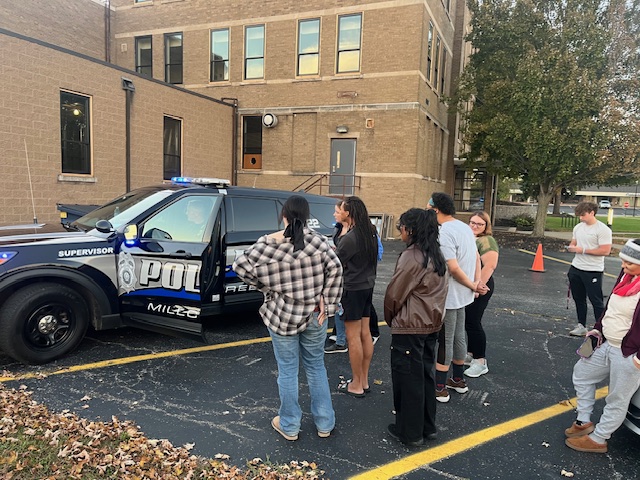
The Associate of Applied Science in Criminal Justice provides students with a comprehensive, practical, and professional knowledge of the Criminal Justice System, consisting of law enforcement, courts, and corrections. Associate degrees like this serve as foundational undergraduate qualifications and are often used as stepping stones for students who wish to pursue further education.
Students will develop a knowledge of the application of the law, social sciences, and criminology to prepare them to advance to the ACT120 Police Academy or transfer to a four-year college or university to obtain a bachelor degree in criminal justice. Earning a bachelor's degree typically takes four years and opens up additional career opportunities in criminal justice and related fields.
Depending on their career goals, students may also consider certificate programs or certificates as short-term, career-oriented educational options that can complement or substitute traditional degrees. The completion of degrees or certificates is important for career readiness and achieving key educational milestones.
Introduction to Criminal Justice
The field of criminal justice is an exciting and ever-evolving area that attracts individuals who are passionate about upholding law and order in society. Pursuing an associate's degree in criminal justice allows students to gain a thorough understanding of the criminal justice system, including the essential roles of law enforcement and corrections. This degree path is ideal for those interested in making a difference, whether by investigating crimes, supporting legal processes, or working as detectives.
Students develop valuable knowledge and skills that prepare them to succeed in a variety of careers, and they gain a deeper understanding of how the criminal justice system works to protect communities and ensure justice. By choosing this educational path, students can set themselves up for career advancement and make a meaningful impact in the fight against crime.
Benefits of Earning an Associate's Degree in Criminal Justice
Earning an associate's degree in criminal justice offers students a range of benefits that can help them achieve their career goals. These degree programs typically take two years to complete and provide a strong foundation in criminology, law enforcement, and the court system. With an associate degree, students are eligible for many jobs in law enforcement, corrections, and private security, giving them a head start in the workforce. The degree also opens doors for career advancement, as graduates can transfer their credits to a bachelor's degree program for further education. Additional benefits include:
- Increased job opportunities in the criminal justice field
- Higher earning potential compared to those without a degree
- Flexibility to pursue a variety of career paths, from police work to legal support roles
- The ability to transfer credits to continue education and reach long-term career goals
Whether students are looking to enter the workforce quickly or plan to continue their education, an associate's degree in criminal justice provides a valuable stepping stone toward a rewarding career.
Program Outcomes
- Analyze the core principles, practices, and skills required for a successful career in criminal justice.
- Examine the functions and roles of all major aspects of the United States criminal justice system in society.
- Identify the role of criminal justice concepts like reasonable suspicion, probable cause, and proof beyond a reasonable doubt in functions like interrogation, arrest, prosecution, and conviction.
- Explain the balance of ethnic, racial, and gender diversity of American society and how they are reflected and projected in the criminal justice system.
- Consider the ethical issues that arise in each component of the criminal justice system.
Career Outlook
Systems created to maintain public order are in every community and therefore provide many jobs. These systems need to be continually created, revised, implemented, and upheld. Individuals working in the criminal justice field provide a valuable service to the public by supporting our criminal justice system and helping to ensure a safe environment for people to live, work, and play.
Occupations that benefit from criminal justice studies include:
- Police Officers
- Detectives
- Private Investigators
- Paralegals
Additional education may open opportunities such as:
- Lawyer
- FBI Agent
- U.S. Marshal
- Forensic Psychologist
Program Courses
Major Requirements (30 Credits)
| Course Number | Course Title | Credits |
|---|---|---|
| CJS 100 | Introduction to Criminal Justice | 3 |
| CJS 103 | Juvenile Justice | 3 |
| CJS 150 | Criminal Law | 3 |
| CJS 170 | Introduction to Corrections | 3 |
| CJS 180 | Introduction to Policing | 3 |
| CJS 190 | Race, Crime, and Justice | 3 |
| PSY 201 | Social Psychology | 3 |
| PSY 210 | Lifespan Development | 3 |
| SOC 250 | Contemporary Social Problems | 3 |
Additional Criminal Justice Requirement
Choose 1 of the following courses (3 Credits)
| Course Number | Course Title | Credits |
|---|---|---|
| CJS 298 | Criminal Justice Internship | 3 |
| CJS 299 | Criminal Justice Capstone | 3 |
Additional Required English/Communication Course
Choose one of the following courses (3 Credits)
| Course Number | Course Title | Credits |
|---|---|---|
| ENG 102 | English Composition II | 3 |
| ENG 110 | Fundamentals of Public Speaking | 3 |
| COM 201 | Effective Interpersonal and Professional Communication | 3 |
Mathematics or Science
Choose one of the following courses (3 or 4 Credits)
| Course Number | Course Title | Credits |
|---|---|---|
| MAT 102 | Mathematical Concepts | 3 |
| MAT 107 | Technical Math | 3 |
| MAT 111 | College Algebra | 3 |
| MAT 202 | Intro to Statistics | 3 |
| BIO 101 | General Biology with Lab | 4 |
| BIO 201 | Anatomy and Physiology I | 4 |
| BIO 202 | Anatomy and Physiology II | 4 |
| BIO 210 | Microbiology | 4 |
| CHM 110 | Introductory to Chemistry I | 4 |
| CHM 111 | Introductory to Chemistry II | 4 |
| EAS 101 | Earth Science: Meteorology with Lab | 4 |
| GLG 220 | Environmental Geology with Lab | 4 |
| PHY 111 | Conceptual Physics | 4 |
Social & Behavioral Sciences (6 Credits)
| Course Number | Course Title | Credits |
|---|---|---|
| SOC 101 | Intro to Sociology | 3 |
| PSY 101 | Intro to Psychology | 3 |
Philosophy/Language/Artistic Expression
Choose one of the following courses (3 Credits)
| Course Number | Course Title | Credits |
|---|---|---|
| ART 101 | Art Appreciation | 3 |
| ENG 201 | Poetry | 3 |
| ENG 207 | Survey of Literature | 3 |
| MUS 101 | Intro to Music | 3 |
| MUS 114 | World Music | 3 |
| PHL 101 | Intro to Philosophy | 3 |
| PHL 111 | Religions of the World | 3 |
Electives
Choose any 4 courses to fulfill this requirement (12 Credits)
| Course Number | Course Title | Credits |
|---|---|---|
| 3 | ||
| 3 | ||
| 3 | ||
| 3 | ||
| 3 |
TOTAL: 20 courses
This information is for planning purposes only. EC3 will make every effort to offer the most updated curriculum information above but reserves the right to change, add, and cancel course offerings. Please check with your assigned advisor for the most updated class information.
Frequently Asked Questions
How many credits is the criminal justice associates degree?
The A.A.S. in Criminal Justice is 60 credits: 30 credits of major courses, a 3-credit internship or capstone, general education in English, math or science, social sciences and humanities, and 12 credits of electives.
What classes do you take for a criminal justice associate degree?
Does this degree prepare me for the police academy in Pennsylvania?
What jobs can I get with an associate degree in criminal justice?
What jobs can I get with an associate degree in criminal justice?
